Google Tag Gateway vs Server-Side Tracking Fix Attribution with GTM, GA4 and Stape (2026)
Quick Answer Google tag gateway vs server-side tracking comes down to scope. Google tag gateway serves your Google tags (GA4 and Google Ads) from your

Quick Answer Google tag gateway vs server-side tracking comes down to scope. Google tag gateway serves your Google tags (GA4 and Google Ads) from your
Quick Answer Google tag gateway vs server-side tracking comes down to scope. Google tag gateway serves your Google tags (GA4 and Google Ads) from your
Quick Answer Server-side tracking sends your website events through a server you control, usually a server-side Google Tag Manager (GTM) container on your own subdomain,
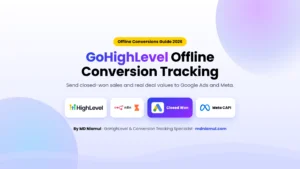
Quick Answer GoHighLevel offline conversion tracking means sending your closed-won sales from the GoHighLevel (GHL) pipeline back to Google Ads and Meta, with the deal
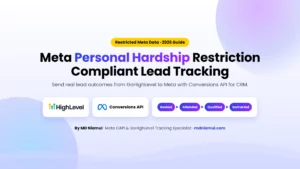
Quick Answer When Meta puts a website in the Personal Hardship category, it limits the data the Pixel and website Conversions API can share. Lower-funnel
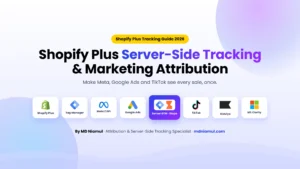
Quick Answer Shopify Plus marketing attribution means giving every ad platform an accurate record of which visits, add-to-carts and orders its ads produced. Browser pixels

Quick Answer A Shopify Meta Pixel and Conversions API audit finds out why Meta receives fewer or messier signals than your store really produces. List
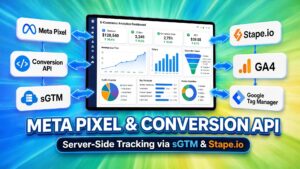
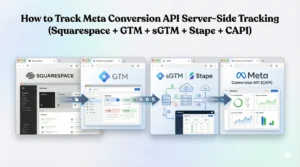
Quick Answer Setting up Meta Pixel and Facebook Conversions API (CAPI) using Server-Side Google Tag Manager (sGTM) hosted on Stape.io establishes a dual-stream tracking framework.
Introduction Imagine you are running high-budget Facebook (Meta) ads for your Squarespace store. Your creatives are stunning, your offer is perfect, and you know people